
How to Read Dog Food Labels: Ingredients and Nutrition Explained
Choosing the right food for your dog can feel overwhelming when you are standing in front of shelves filled with different brands, flavors, and nutritional claims. Some packages highlight high protein, others advertise natural ingredients, and many use terms that sound impressive but can be difficult to understand.
The good news is that learning how to read dog food labels can make shopping much easier. The information printed on packaging can help you understand what a product contains, which life stage it is designed for, and whether it provides complete nutrition.
However, knowing where to look is just as important as knowing what the words mean.
In this guide, we will explain the main sections of dog food labels, how to interpret nutritional percentages, and what to consider before choosing a product for your pet.
1. Start With the Nutritional Adequacy Statement
One of the most important sections of a dog food package is the nutritional adequacy statement.
This information tells you whether the product is intended to provide complete nutrition and which life stage it is formulated for.
Look for wording such as:
- Complete and balanced for adult maintenance.
- Complete and balanced for growth.
- Complete and balanced for all life stages.
A complete food is designed to provide the required nutrients when fed as the sole diet according to its intended use. A balanced food provides those nutrients in appropriate proportions.
In the United States, products making an AAFCO nutritional adequacy claim must meet the applicable nutrient profile or substantiate the claim through an appropriate feeding trial.
Remember that treats, snacks, and supplements are generally not intended to replace a complete daily diet.
The FDA guide to complete and balanced pet food explains how these nutritional claims work.
2. Understanding the Ingredient List
The ingredient list provides information about the components used to make the food.
In the United States, ingredients are generally listed in descending order by weight before processing.
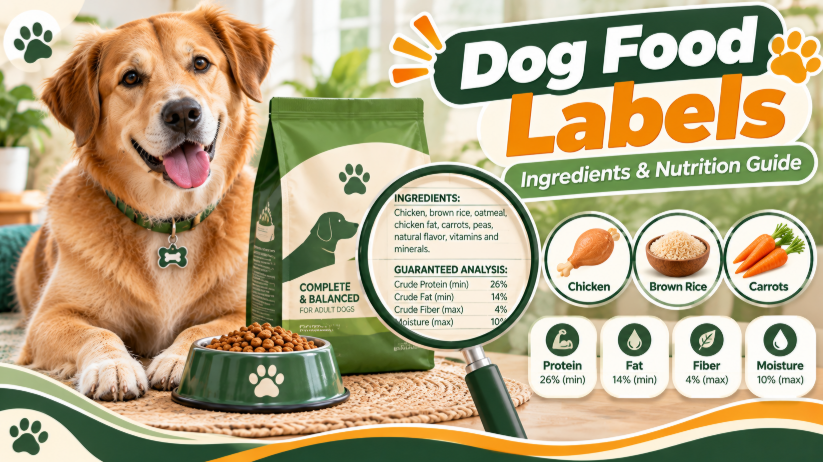
For example, a hypothetical ingredient list might look like this:
- Chicken.
- Brown rice.
- Chicken fat.
- Oatmeal.
- Beet pulp.
- Vitamins and minerals.
This tells you which ingredients contribute the greatest weight when the formula is prepared.
However, there is something important to remember: ingredient order does not automatically reveal the final nutritional quality of the food.
Ingredients containing considerable moisture may appear higher on the list than concentrated ingredients. Processing also changes the original weight of ingredients.
Therefore, do not choose a product based exclusively on whether meat appears first.
Instead, evaluate the complete formula, its nutritional adequacy statement, and the manufacturer's information.
3. What Does Guaranteed Analysis Mean?
The guaranteed analysis is another important part of dog food packaging.
It provides information about certain nutrient levels in the product.
In the United States, the basic guarantees generally include:
Crude protein: The minimum percentage of protein guaranteed in the food.
Crude fat: The minimum percentage of fat guaranteed.
Crude fiber: The maximum percentage of crude fiber.
Moisture: The maximum percentage of water.
You may also see additional guarantees for nutrients such as calcium, phosphorus, or omega fatty acids.
For example, a hypothetical dry dog food label might show:
| Nutrient | Guaranteed amount |
|---|---|
| Crude Protein | 26% minimum |
| Crude Fat | 14% minimum |
| Crude Fiber | 4% maximum |
| Moisture | 10% maximum |
These numbers help describe the food, but they do not provide a complete nutritional analysis.
The word "crude" refers to the analytical method used to measure the nutrient. It does not mean the ingredient is poor quality.
For additional details, consult the AAFCO guide to reading pet food labels.
4. Why Moisture Matters When Comparing Dog Foods
One common mistake is comparing protein percentages between dry and wet dog foods without considering their different moisture levels.
Wet food naturally contains considerably more water than dry kibble. As a result, its guaranteed protein percentage may appear lower even when the actual nutrient concentration is comparable.
To make a fair comparison, you can calculate the dry matter basis.
Use this formula:
Dry Matter Percentage = 100 − Moisture Percentage
Then:
Nutrient on Dry Matter Basis = (Nutrient Percentage ÷ Dry Matter Percentage) × 100
For example, imagine a wet food contains:
- 12% crude protein.
- 78% moisture.
Its dry matter percentage is 22%.
The protein percentage on a dry matter basis would be:
(12 ÷ 22) × 100 = 54.5%.
This calculation helps you compare products with different moisture contents more accurately.
However, comparing protein alone does not establish which food is better. You should also consider the complete nutrient profile, calorie content, and your dog's requirements.
5. Understanding Calories on Dog Food Labels
Calories determine how much energy your dog receives from its meals.
In the United States, pet food labels include calorie information, generally expressed as kilocalories per kilogram and per familiar serving unit, such as a cup, can, or biscuit.
For example, a package might indicate:
- 3,600 kcal/kg.
- 360 kcal per cup.
This information can help you estimate daily food portions.
However, two foods with similar serving sizes may contain different amounts of energy.
Your dog's calorie requirements depend on factors such as:
- Age.
- Body weight.
- Activity level.
- Body condition.
- Individual health requirements.
Use the feeding instructions as a starting point and ask your veterinarian whether the recommended amount is appropriate.
6. What Do Marketing Terms on Dog Food Packages Mean?
Dog food packaging often includes attractive words intended to communicate product characteristics.
Some examples include:
Natural: This term generally describes certain ingredient or processing characteristics, depending on the applicable regulations. It does not automatically mean the food is nutritionally superior.
Premium: Often used as a marketing description rather than a standardized measure of nutritional quality.
Grain-free: Indicates that the formula does not contain conventional cereal grains. It does not necessarily mean the food is healthier or more nutritious.
High protein: Suggests a higher protein content, but the actual amount and overall nutritional balance still need to be evaluated.
Chicken flavor: Describes the intended flavor rather than necessarily indicating that chicken is the main ingredient.
The important lesson is to look beyond large promotional words on the front of the package and examine the nutritional information on the back.
7. How to Evaluate a Dog Food Manufacturer
The information on the package is useful, but understanding who makes the food is equally important.
A responsible manufacturer should be able to explain how its products are developed and monitored.
The World Small Animal Veterinary Association (WSAVA) recommends asking manufacturers questions such as:
- Do you employ a qualified animal nutritionist?
- Who formulates your products?
- Are your foods evaluated through feeding trials or nutrient analysis?
- What quality-control procedures are used?
- Can you provide a complete nutrient analysis?
- Where are your products manufactured?
These questions can help you evaluate the information behind a product rather than relying entirely on advertising.
You can consult the WSAVA Global Nutrition Toolkit for additional guidance on selecting pet foods.
8. Common Mistakes When Reading Dog Food Labels
Even experienced dog owners can misunderstand certain parts of pet food packaging.
Avoid these common mistakes:
- Choosing food based only on the first ingredient.
- Assuming expensive products are automatically better.
- Comparing wet and dry food percentages without adjusting for moisture.
- Confusing minimum nutrient guarantees with exact nutrient amounts.
- Assuming grain-free products are always healthier.
- Ignoring the nutritional adequacy statement.
- Forgetting to check the calorie content.
A better approach is to evaluate the complete label rather than focusing on one attractive feature.
For additional guidance, read our Complete Guide to Dog Nutrition, where we explain the essential nutrients dogs need.
Frequently Asked Questions About Dog Food Labels
What is the most important information on a dog food label?
The nutritional adequacy statement is particularly important because it identifies the intended species and life stage and indicates whether the food is formulated as complete and balanced nutrition.
Does the first ingredient determine food quality?
No. Ingredients are listed by weight before processing, and moisture content can influence their position. Evaluate the entire nutritional formula.
What does crude protein mean?
It refers to the analytical method used to measure protein content. It does not indicate that the protein is inferior.
Is grain-free dog food better?
Not necessarily. Grain-free food is not automatically healthier or more appropriate. Your dog's individual nutritional requirements should guide your choice.
Can I compare protein percentages between wet and dry dog food?
Yes, but you should first adjust the values to a dry matter basis to account for different moisture levels.
Conclusion
Learning how to read dog food labels can help you become a more informed pet owner. By understanding ingredient lists, guaranteed analysis, nutritional adequacy statements, and calorie information, you can evaluate products more confidently.
Remember that attractive packaging and marketing claims do not necessarily reflect nutritional quality.
Focus on complete and balanced nutrition, appropriate life-stage recommendations, reliable manufacturers, and your dog's individual needs.
When you are uncertain about a particular product, your veterinarian can help you determine whether it is an appropriate choice for your companion.
Deja un comentario