
Organic Dog Food: Benefits, Differences, and What Owners Should Know
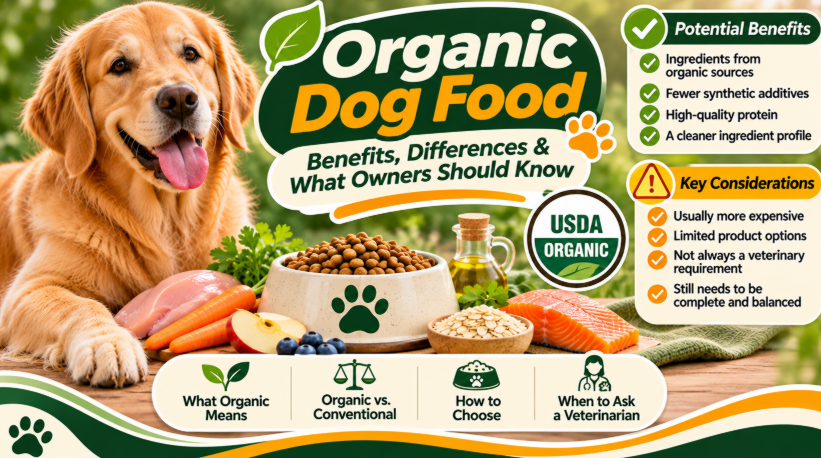
More dog owners are becoming interested in organic food as they look for different ways to support their pets' nutrition. From organic chicken and vegetables to specially formulated kibble, these products are becoming increasingly visible in pet food stores.
But is organic dog food actually better? What does the word organic mean, and how can you recognize a genuinely certified product?
Understanding these questions can help you make informed decisions without paying extra for marketing claims that may not provide additional nutritional value.
In this guide, we will explore organic dog food, its potential advantages, its limitations, and what to consider before choosing it for your companion.
1. What Is Organic Dog Food?
Organic dog food is made using ingredients produced according to recognized organic agricultural and processing standards.
Depending on the certification system, these standards may regulate farming practices, permitted substances, livestock management, and how ingredients are handled during production.
Organic agricultural production generally emphasizes:
- Soil and water conservation.
- Biodiversity.
- Approved agricultural production methods.
- Restrictions on certain synthetic substances.
- Responsible livestock production practices.
In the United States, the USDA National Organic Program establishes organic certification and labeling requirements.
According to the USDA organic labeling standards, products labeled organic must meet specific requirements and undergo appropriate certification.
It is important to understand that organic describes how ingredients are produced and processed. It does not automatically mean a food is nutritionally superior.
2. Organic vs. Conventional Dog Food
The main difference between organic and conventional dog food is the production method used for their ingredients.
Organic foods follow specific certification standards, while conventional foods may use ingredients produced through other legally permitted agricultural practices.
| Feature | Organic Dog Food | Conventional Dog Food |
|---|---|---|
| Ingredient production | Follows organic standards | Follows applicable food production regulations |
| Certification | Requires appropriate organic certification for organic claims | Organic certification not required |
| Ingredient sourcing | Uses certified organic ingredients according to its labeling category | May combine different ingredient sources |
| Nutritional quality | Depends on the complete formulation | Depends on the complete formulation |
| Price | Often more expensive | Available at a wider range of prices |
Neither category automatically guarantees better nutrition.
The most important consideration is whether the food provides complete and balanced nutrition appropriate for your dog's life stage.
3. Common Ingredients in Organic Dog Food
Organic dog food can contain many familiar ingredients, provided they meet the applicable production and certification requirements.
Some examples include:
Organic chicken: Provides animal protein and essential amino acids.
Organic beef: Supplies protein and nutrients such as iron and zinc.
Organic salmon: Provides protein and can contribute omega-3 fatty acids.
Organic brown rice: Supplies carbohydrates and contributes energy.
Organic oats: Provide carbohydrates and dietary fiber.
Organic vegetables: Ingredients such as carrots and peas can contribute fiber and other nutrients.
The nutritional value of these ingredients depends on their amounts, preparation, digestibility, and combination within the complete formula.
For more information about protein selection, see our guide to the best protein sources for dogs.
4. Understanding Organic Dog Food Certifications
One of the most important steps when shopping for organic dog food is understanding what the certification actually represents.
In the United States, the USDA organic labeling system includes different categories.
100% Organic
The product must contain entirely certified organic ingredients, excluding water and salt.
Organic
The product must contain at least 95% certified organic ingredients, excluding water and salt, subject to applicable requirements.
Eligible products may display the USDA Organic seal.
Made With Organic Ingredients
Products in this category must contain at least 70% organic ingredients, excluding water and salt.
They can identify specified organic ingredients or ingredient categories, but cannot display the USDA Organic seal as an organic product.
These distinctions help consumers understand how much of a product is certified organic.
For additional information, visit the USDA National Organic Program.
5. Potential Benefits of Organic Dog Food
Some owners choose organic dog food because they prefer ingredients produced under specific agricultural standards.
Potential advantages include:
- Greater transparency about certified ingredient production.
- Agricultural practices emphasizing soil and biodiversity conservation.
- Restrictions on certain production methods and substances.
- A purchasing option that aligns with personal environmental preferences.
However, there is an important distinction between production standards and nutritional benefits.
According to AAFCO's guidance on organic pet food, organic certification does not automatically mean a food is safer, healthier, or more nutritious than conventional alternatives.
Therefore, avoid choosing a product simply because its packaging says organic.
6. Are There Any Disadvantages?
Organic dog food also has limitations worth considering.
Higher prices: Certified ingredients and production requirements can increase manufacturing costs.
Limited availability: Some areas have fewer organic pet food options.
Marketing confusion: Words such as natural, premium, and organic are not interchangeable.
Nutritional differences: An organic formula may not be appropriate for every dog, especially if it does not meet the animal's specific nutritional requirements.
Always evaluate the actual nutritional formulation rather than relying exclusively on the product's marketing.
7. How to Choose a Good Organic Dog Food
Before purchasing an organic formula, consider these important points:
Check the certification: Look for appropriate certification information and understand what the organic claim represents.
Read the ingredient list: Review the ingredients and their nutritional contribution.
Check nutritional adequacy: Look for a complete and balanced food appropriate for your dog's life stage.
Consider protein quality: Evaluate the protein sources and overall formulation.
Compare calorie content: Different formulas can have different energy densities, even when they contain similar ingredients.
Consider your dog's individual needs: Age, activity, body condition, and medical requirements all matter.
Our guide to reading dog food labels explains how to evaluate ingredient statements and nutritional information.
8. Is Organic Dog Food Worth the Extra Cost?
Whether organic dog food is worth purchasing depends on your priorities and budget.
If certified agricultural production is important to you, organic food may be an option worth considering.
However, spending more does not automatically guarantee better nutritional results.
A reasonably priced conventional food that provides complete and balanced nutrition may be a better choice than an expensive organic product with an unsuitable nutritional profile.
You should also consider the manufacturer's quality-control practices and the nutritional research supporting its formulas.
For more information, see our article about dog food ingredients to avoid.
Frequently Asked Questions About Organic Dog Food
Is organic dog food healthier than regular dog food?
Not necessarily. Organic certification describes production practices, not guaranteed nutritional superiority.
Does organic dog food contain fewer chemicals?
Organic standards restrict certain substances and production methods. However, organic does not mean completely free of chemicals or naturally occurring substances.
Can puppies eat organic dog food?
Yes, provided the formula is complete and balanced for growth and appropriate for the puppy's expected adult size.
Is organic dog food better for dogs with allergies?
Not automatically. Food allergies involve reactions to particular ingredients or proteins. Organic certification does not eliminate potential allergens.
How can I identify certified organic dog food?
Check the certification information and labeling category. In the United States, the USDA Organic seal can help identify eligible certified products.
Conclusion
Organic dog food offers an alternative for owners who prefer ingredients produced under recognized organic agricultural standards.
However, organic certification should not be confused with guaranteed nutritional superiority. A dog's health depends on receiving the right nutrients in appropriate amounts, regardless of whether those nutrients come from organic or conventional ingredients.
Before choosing an organic formula, examine its certification, ingredients, nutritional adequacy statement, and suitability for your dog's life stage.
Ultimately, the best food is one that provides balanced nutrition, meets your dog's individual needs, and fits comfortably within your feeding budget.
Deja un comentario